|
The word based application forms (AF) have been replaced by electronic application
forms
(eAF), with new possibilities like electronic data import/export, data population within the
form,
online access to standardised catalogue terms, built in business rule validation, and support for
validation of form, etc. Implementation of mandatory use of the eAF is part of the HMA eSubmission roadmap.
The electronic forms and supporting technical documentation are available below.
News
Previous news can be found here.
17-08-2026
Veterinary marketing authorisation application (MAA) form naming for Centrally
Authorised Products (CAPs)
To support the automated processing of CAP (centrally authorised products)
Veterinary marketing authorisation application (MAA) submissions at EMA, the electronic
Application Form (Vet MAA interactive PDF eAF) included in the VNeeS package must follow a
specific file naming convention. The eAF filename must contain the text:
ema-form-eaf. Additional information may be included in the filename, provided
that the string ema-form-eaf remains present.
Examples of acceptable filenames:
- ema-form-eaf.pdf
- ProductName_ema-form-eaf.pdf
- ema-form-eaf_ProductName_v1.pdf
Please note:
- The text ema-form-eaf should be used only for the MAA eAF
file.
- No other file within the submission package should contain
ema-form-eaf in its filename.
EMA internal systems (IRIS) identify the eAF through an automated search for the
string ema-form-eaf. If the naming convention is not respected, the system may
be unable to identify the eAF correctly. As part of validation, submissions will be checked for
compliance with this requirement. Where the naming convention has not been followed, applicants
may be requested to resubmit the package with the correct filename.
Applicants are therefore encouraged to verify the eAF filename before submission to
avoid validation issues and potential delays in processing.
04-08-2026
Human MAA eAF v1.28.0.0 - minor version available
Minor version 1.28.0.0 of the interactive PDF
electronic application form (eAF) for human marketing authorisation
application is available on the eAF website.
The new version brings a minor change, affecting the substances
dropdown in section 2.6.1.
The previously published version 1.28.0.0 should be exported and
re-imported in the newly published PDF. The steps are explained in the
following guidance, page 10: Technical User Guide for eAF.pdf.
Reminder: all the new form that are published
need to 'Trusted'.
Follow the Practical user guide for electronic Application
Forms (eAF) for
human and veterinary products in the EU, page 11.
For the implementation timeline of the 1.28.0.0 MAA
forms, please consult the news from 30 June.
03-08-2026
Veterinary MAA eAF v1.28.0.0 - minor version available
Minor version 1.28.0.0 of the interactive PDF
electronic
application form (eAF) for veterinary marketing authorisation
application is
available on the eAF website.
The new version brings a minor change, affecting the list of
member states for sections 2.4.1 and 2.4.4 (UK(NI) is now included).
The previously published version 1.28.0.0 should be exported and
re-imported in the newly published PDF. The steps are explained in the
following guidance, page 10: Technical User Guide for eAF.pdf.
Reminder: all the new form that are published
need to 'Trusted'.
Follow the Practical user guide for electronic Application
Forms (eAF) for
human and veterinary products in the EU, page 11.
For the implementation timeline of the 1.28.0.0 MAA Veterinary
forms, please consult the news from 30 June.
28-07-2026
Veterinary MAA eAF v1.28.0.0 - minor version available
Minor version 1.28.0.0 of the interactive PDF
electronic
application form (eAF) for veterinary marketing authorisation
application is
available on the eAF website.
The new version brings a minor technical change, affecting the
extract of the information from the PDF from section 1.1.3.
The previously published version 1.28.0.0 should be exported and
re-imported in the newly published PDF. The steps are explained in the
following guidance, page 10: Technical User Guide for eAF.pdf. After the
import, if applicable, section 1.1.3 needs to be re-populated manually.
Reminder: all the new form that are published
need to 'Trusted'.
Follow the Practical user guide for electronic Application
Forms (eAF) for
human and veterinary products in the EU, page 11.
For the implementation timeline of the 1.28.0.0 MAA Veterinary
forms, please consult the news from 30 June.
23-07-2026
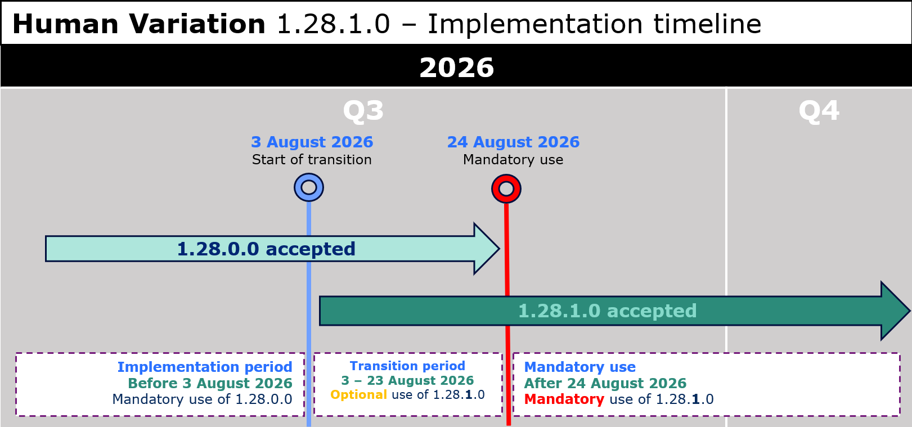
Human Variation interactive PDF eAF v1.28.1.0 version
available
Minor version 1.28.1.0 of the interactive PDF electronic
application form (eAF) for human variation application is
available on the eAF website, together with the associated release notes.
The new version brings the annual update checkbox (and the earliest
implementation date), mandatory use of OMS for 3 sections and small bug fix.
The changes are included in the release notes for 1.28.0.0.
The form can be used for new human variation applications
submitted to EMA and NCAs from 3 August 2026. It
will be mandatory to use the updated form for all
new human variations submissions from 24 August
2026.
Applicants are reminded that the version of the form should
not
be changed during an ongoing procedure.
AND
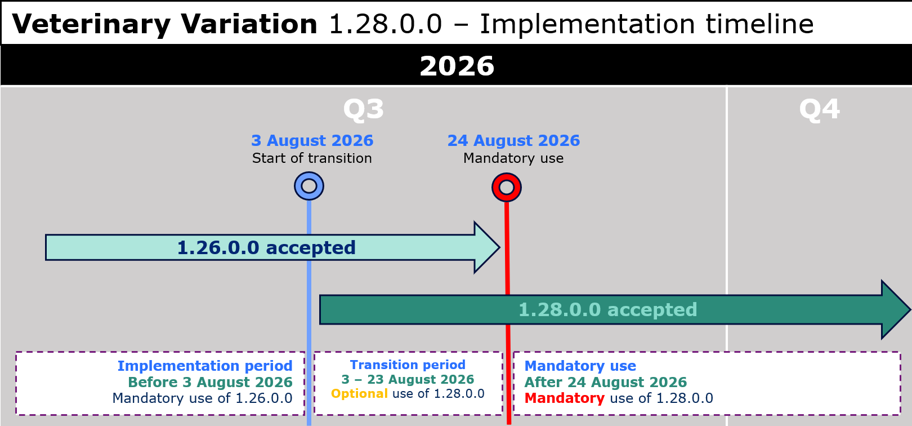
Veterinary Variation interactive PDF eAF v1.28.0.0 version
available
Minor version 1.28.0.0 of the interactive PDF electronic
application form (eAF) for veterinary variation application
is available on the eAF website. Relevant release notes will be published at
a later date.
The new version brings a change in the display of the section
4c.
The form can be used for new veterinary variation
applications submitted to EMA and NCAs from 3 August
2026. It will be mandatory to use the updated form
for all new veterinary variations submissions from 24
August 2026.
Applicants are reminded that the version of the form should
not be changed during an ongoing procedure.
21-07-2026
PLM portal eAF and interactive PDF eAF human variation
known issue
The conditions and documentations for the variation scopes are
shown with their term name (short name, and for very few entries also
truncated) instead of the term description (long name).
For example, for Q.II.e.2.a, one of the conditions and one of the
documentations are both “truncated”:
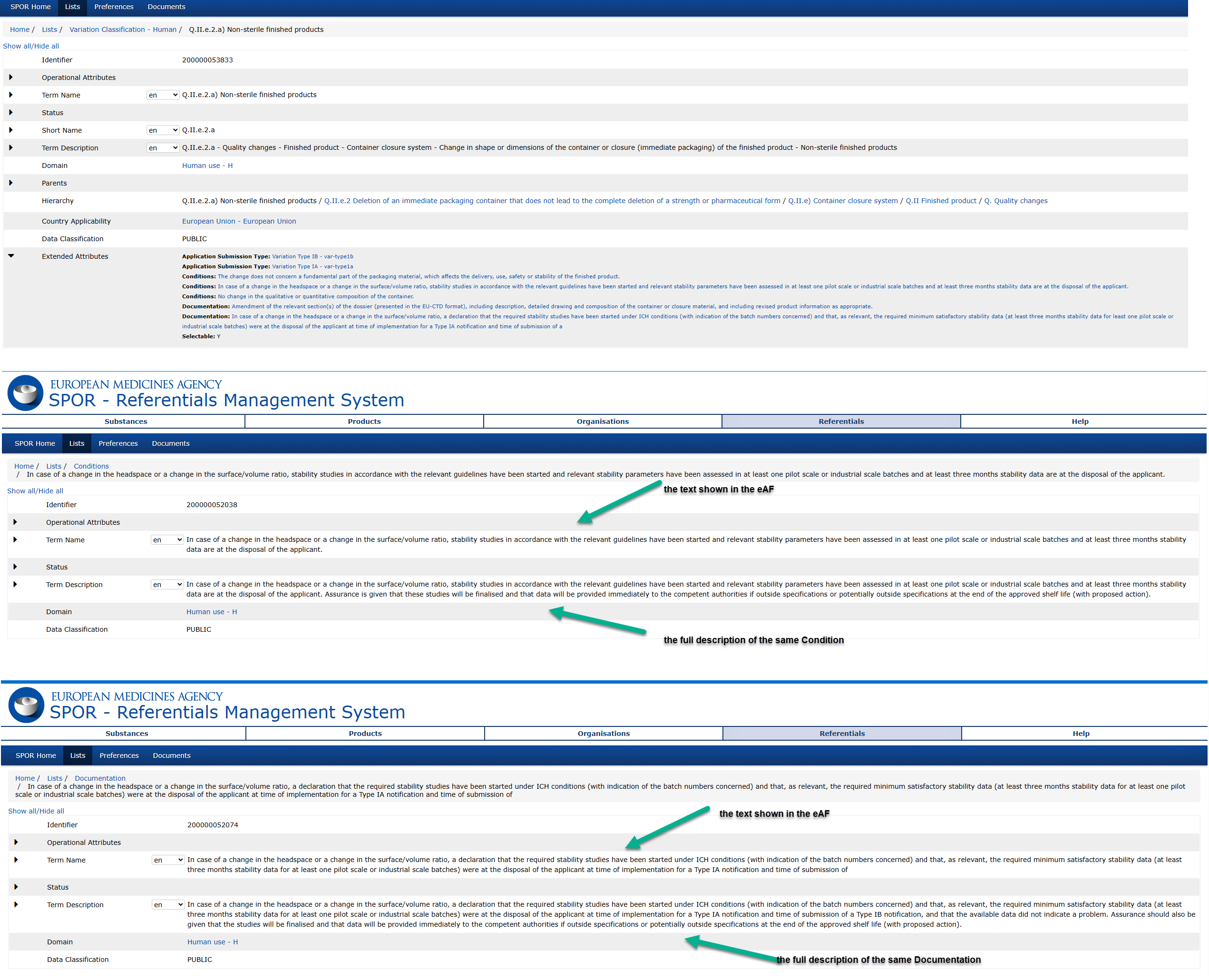
This behaviour will be addressed in the upcoming period. The
users are encouraged to send the form as is, and to mention in the cover
letter that this is the current behaviour of the form, and that the
responsible EMA team will change it in a future version.
Please follow the eSubmission eAF page and the PLM portal release notes to
be notified of the resolution.
14-07-2026
Human and Veterinary MAA eAF v1.28.0.0 - minor versions
available
Minor versions 1.28.0.0 of the interactive PDF
electronic
application form (eAF) for human and veterinary marketing
authorisation
application are available on the eAF website, together with the
associated
updated release notes.
The new versions bring bug fixes in both forms, and the changes are included
at the beginning of the release notes for 1.28.0.0.
The previously published version 1.28.0.0 can be exported and
re-imported in the newly published PDFs. The steps are explained in the
following guidance, page 10: Technical User Guide for eAF.pdf
For the implementation timeline of the 1.28.0.0 MAA Human and
Veterinary forms, please consult the news from 30 June.
30-06-2026
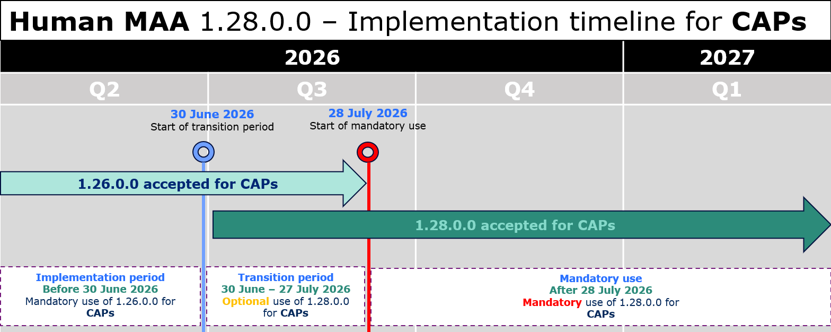
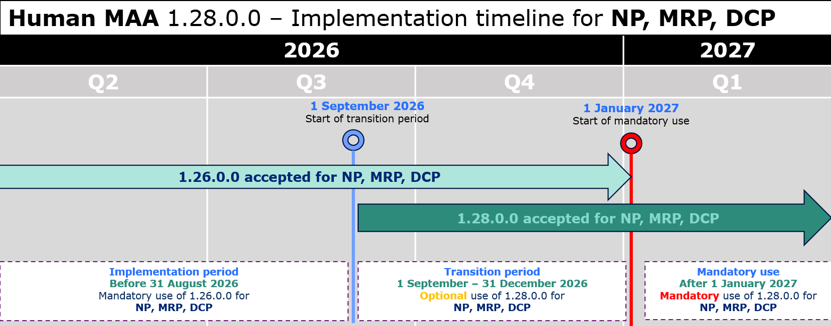
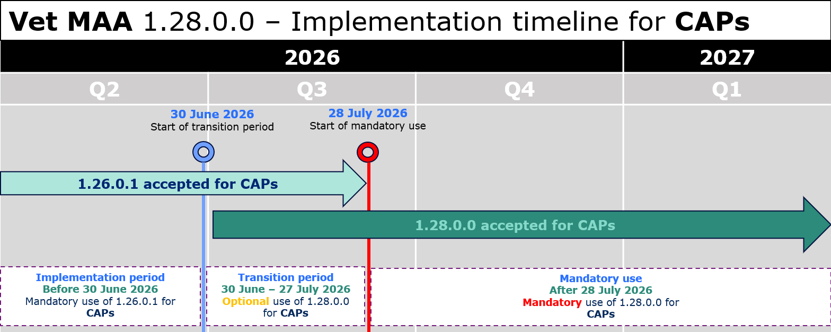
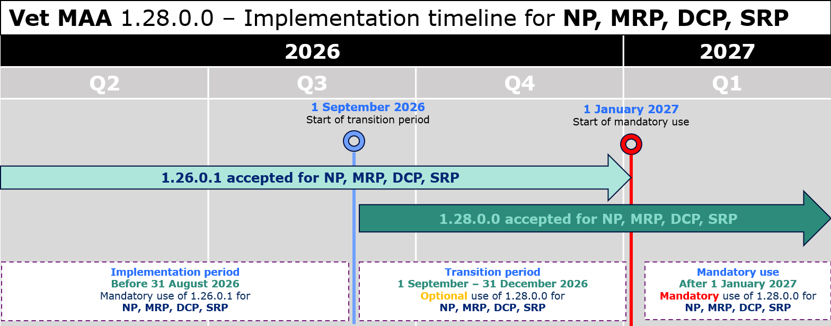
Human and Veterinary MAA eAF v1.28.0.0 - timeline for implementation
Versions 1.28.0.0 of the interactive PDF electronic application form (eAF) for
human and veterinary marketing authorisation application are available on the
eAF website, together with the associated release notes.
Industry must use the updated eAFs, Version 1.28.0.0, for any new CAP MAA Veterinary
or Human application submitted to EMA from 28 July 2026.
The forms can be used for new MAA applications submitted to the NCAs for NP, MPR,
DCP and SRP procedures from 1st September 2026. It will
be mandatory to use the updated forms
for all new MAA submissions to the NCAs from 1st January 2027.
Applicants are reminded that the version of the form should not be changed
during an ongoing procedure.
23-06-2026
Veterinary MAA eAF v1.28.0.0 now available for
testing/UAT
Version 1.28.0.0 of the interactive PDF
electronic application form (eAF) for veterinary marketing
authorisation application (Vet MAA) is now available on the eAF
website, together with the associated release notes.
The changes made in version 1.28.0.0 for the Veterinary MAA aim
to align the form with the VMP Regulation (including the new section: SRP -
Subsequent Recognition Procedure) and to address structural limitations in
the current form and support alignment with the ISO Identification of
Medicinal Products (IDMP) data model. As regulatory data management evolves,
the eAF needs to support a more structured and interoperable representation
of medicinal product information across the EU regulatory network.
Following the successful completion of internal user acceptance
testing (UAT), EMA is now extending testing to a broader group. Marketing
authorisation holders are encouraged to complete the form using real or mock
data-preferably reflecting complex product compositions and packaging-and to
report any issues as soon as possible, and no later than 26 June
2026 at 18:00 CET, by submitting a ticket via the Request information about eAF - interactive PDF -
Employee Center. Please note that the form must be
"trusted" before use.
Industry must use the updated eAFs, Version 1.28.0.0, for
any new CAP MAA Veterinary submission to EMA
from 28 July 2026 onwards. For all other types
of , use of the updated eAFs is expected to become mandatory after
1 September, at a later date which will be announced after
alignment with relevant stakeholders. The date and further transition
details will be shared through the eSubmission
website.
AND
Human MAA eAF v1.28.0.0 - update on mandatory use for CAPs
and new minor version available
Minor version 1.28.0.0 of the interactive PDF
electronic application form (eAF) for human marketing authorisation
application (Human MAA) is now available on the eAF website.
Industry must use the updated eAF, Version 1.28.0.0, for
any new CAP MAA Human submission to EMA
from 28 July 2026 onwards. For all other types
of products, use of the updated eAFs is expected to become
mandatory after 1 September, at a later date which will be announced after
alignment with relevant stakeholders. The date and further transition
details will be shared through the eSubmission
website.
03-06-2026
Human MAA eAF v1.28.0.0 now available for testing
Version 1.28.0.0 of the interactive PDF electronic
application form (eAF) for human marketing authorisation
application (MAA) is now available on the eAF website, together
with the associated release notes.
The changes made in version 1.28.0.0 for the Human MAA aim to address
structural limitations in the current form and support alignment with the
ISO Identification of Medicinal Products (IDMP) data model. As regulatory
data management evolves, the eAF needs to support a more structured and
interoperable representation of medicinal product information across the EU
regulatory network.
The proposed changes do not modify the regulatory intent or the type of
information collected in the form. Rather, they improve how this information
is structured and captured, enabling a more accurate representation of
complex medicinal products and ensuring that key product attributes (such as
product composition, packaging, manufacturing responsibilities and
administration characteristics) can be described in a consistent and
machine-readable way.
Following the successful completion of internal user acceptance testing
(UAT), EMA is now extending testing to a broader group. Marketing
authorisation holders are encouraged to complete the form using real or mock
data-preferably reflecting complex product compositions and packaging-and to
report any issues as soon as possible, and no later than 9 June 2026
at 18:00 CET, by submitting a ticket via the Request information about eAF - interactive PDF -
Employee Center. Please note that the form must be
"trusted" before use.
Subject to a successful testing phase, concluding on 9 June
2026, the form is expected to become mandatory from 1
September 2026. Further details regarding the mandatory transition
will be communicated in due course.
16-04-2026
Adoption survey for PLM Portal web-based electronic Application Form (eAF) users
As part of EMA’s commitment to continuous improvement, the eAF team has published an adoption survey to gather inputs and feedback on the PLM Portal web-based electronic Application Form (eAF), you can access the survey by clicking this link:
https://ec.europa.eu/eusurvey/runner/eAF_Change_Adoption_Survey.
This survey aims to assess your level of satisfaction with PLM Portal web-based eAF use, as well as your experience with user support resources and communication. It also aims to identify potential concerns or challenges and provide valuable insights to help the eAF team implement necessary improvements or mitigation measures.
We invite you to share your feedback on your experience as users of the PLM Portal web-based electronic Application Form (eAF) by filling in this adoption survey by 24 April 2026.
The survey will take only a few minutes to complete. Your responses will remain anonymous, and the results will not be publicly disclosed..
Your participation is highly appreciated, and we thank you in advance for your time and input.
13-04-2026
Mandatory Use of PLM Web-Based eAF for CAPs – 1 September 2026
The strongly recommended use of the PLM web-based electronic Application
Form (eAF) for Centrally Authorised Products (CAPs) has been in place since
July 2024. Over the past two years, submissions via the PLM eAF have steadily increased.
To continue advancing the adoption of the PLM web-based eAF, the European
Medicines Agency (EMA) will introduce mandatory use for CAPs as of 1 September 2026.
Why is this change being introduced?
The PLM web-based eAF enables faster and more accurate automated processing
of application forms. It also supports integration with other EMA systems,
contributing to a more efficient and streamlined submission and approval process.
By contrast, the interactive PDF eAF may present technical issues that can
lead to rejection of submissions. It is also slower to process and does not
support the same level of system integration as the web-based solution.
How to prepare for mandatory use
Before 1 September 2026, users of the PLM portal eAF are advised to:
What will happen after 1 September 2026?
From 1 September date onwards, any human CAP variation submissions sent to
EMA using the interactive PDF eAF will be rejected unless it is accompanied
by a valid and justified technical reason preventing the use of the PLM web-based eAF.
Possible technical reasons preventing the use of PLM eAF
The following known technical limitations may justify the use of the interactive PDF eAF:
-
Performance issues for large applications: The PLM portal currently has
performance limitations when handling large applications of over
approximately 200 medicinal products. Improvements for large applications
are planned for 2026.
-
Medical Devices section: a known issue in this section requires the continued use of the interactive PDF eAF.
-
PMS data issues: A full list of known PMS issues is
available in the PMS FAQ document
(page 16), including expected resolution timelines.
Examples include: duplicated products or packages, duplicated entries, truncated product names.
Applicants should review this list and follow recommended actions before submitting a support ticket.
-
OMS data issues: Issues in the intermediate data layer (dataverse)
may impact organisational data used in the eAF. A platform-level review is ongoing.
Existing and future workarounds aim to address synchronisation issues, including those related to contact persons and proof of payment.
-
Lack of access to the PLM portal: Some organisations have not yet enabled co-authoring or
provided access to all required users (e.g. in worksharing scenarios). In such cases, the interactive PDF eAF remains the only viable option.
-
Other (unknown) technical issues: Unlisted technical issues
may also be accepted, provided they are flagged on time and impede the correct finalisation
of a PLM portal form. If users encounter issues close to a submission deadline that block the completion of the PLM web-based eAF, they may use the interactive PDF eAF.
Further details on how to justify the exceptional use of the PDF eAF will be communicated prior to the beginning of the Mandatory use for CAPs.
Additional guidance
-
Users should raise a service desk ticket for issues that may be resolvable
(e.g. PMS, OMS, or newly identified issues): https://support.ema.europa.eu/esc
-
Requests will be handled based on priority and order of receipt, with feedback provided on resolution timelines.
-
If the estimated resolution time conflicts with a submission deadline, applicants should use the interactive PDF eAF.
-
If service desk response times are longer than expected, the interactive PDF eAF may be used.
For known limitations such as large applications, Medical Devices issues, or lack of
PLM portal access, users are not required to raise a service desk ticket.
Please follow the PLM portal and eSubmission for updates on the mandatory use of the
PLM portal eAF for CAPs and on how to report any impediments.
Forms
Please note that applicants should use Adobe Reader or Adobe Reader DC for locking the
forms. Adobe Acrobat or Acrobat Pro DC should not be used for filling and locking the forms as
this
may cause issues when the locked forms are opened/viewed by the recipient who may be using Adobe
Reader/Adobe Reader DC.
Currently accepted versions of forms:
For the UK, as from 1.1.2021, EU Law applies only to the territory of Northern
Ireland
(NI) to the extent foreseen in the Protocol on Ireland/NI.
Version 1.26.0.0
Human MAA (will be decommissioned, see news from 30 June 2026)
Renewal
Veterinary Variation
Version 1.26.0.1
Veterinary MAA (will be decommissioned, see news from 30 June 2026)
Version 1.27.0.1
Human Variation
Version 1.28.0.0
Human MAA
*Application form for marketing authorisation for veterinary medicinal products according to Regulation EU 2019/6 and for specific variations requiring assessment1
1variations requiring assessment classified as changes of active substance(s), strength, pharmaceutical form, route of administration or food-producing target species in chapter I of EMA/CMDv Guidance on the details of the classification of variations requiring assessment according to Article 62 of Regulation (EU) 2019/6 for veterinary medicinal products and on the documentation to be submitted pursuant to those variations
Guidance Documents
Regulatory
Technical
Q & A
| Questions and Answers document on Mandatory use of OMS |
CAPs OMS Mandatory Q&A 11.10.2021 |
| Variation eAF v1.25.0.0 presentation on changes to users |
Presentation 01.10.2021 |
| Variation eAF v1.24.0.1 presentation on changes to users |
Presentation 15.12.2020 |
| User Guidance Human & Vet |
Questions and Answers 01.03.2019 |
| Variation eAF v1.24.0.0 presentation on changes (to applicants) |
Presentation26.10.2020
|
| Variation eAF v1.24.0.0 presentation on changes (to NCAs) |
Presentation26.10.2020
|
| eAF for industry |
Presentation |
| How to complete an eAF based on version 1.20 |
Presentation 15.11.2016 |
Multimedia webinars and training
eAF Term Request process
If you need to request a new substance in order to complete an eAF, please submit a request for substance insertion with the corresponding SmPC to the EMA Service Desk portal.
If you need to request a new term (e.g. pharmaceutical form or unit of measurement) or an update of an already existing term in order to complete the eAF, please submit a request through the Referential Management Services (RMS) of the SPOR portal providing as much supporting documentation as possible (e.g. name of the product concerned, SmPC, justification for the request, etc.). The ‘RMS Web User Manual’, which provides a step-by-step guide on how to submit change requests, can be found under the 'Documents' section of the RMS portal.
Please note that you need to be registered with SPOR prior to the submission of change requests. The ‘SPOR User Registration Manual’, which provides detailed information on how to register in SPOR, can be found under the 'Document' section of the RMS portal. The user guide for managing referential and organisation data in eAF is available here.
Technical Documents
The Data Exchange Standards and XML Schema Definitions published here are intended to allow software developers within other organisations to develop systems to process the electronic application form data and build equivalent systems, if required. The EMA will ensure that the latest versions of these documents are published here.
Current version of technical documents:
Version 1.26.0.0
Human forms available for use from 1st of December 2021. Mandatory use from 1st of January 2022.
Veterinary forms available for use from 28th January 2022. Mandatory use from 28th January 2022.
For technical support, visit the EMA Service Desk portal: https://support.ema.europa.eu/esc
Links
Archives
As of 1.2.2020, the UK is no longer an EU Member State. However, EU law still applies to the UK during the transition period. |